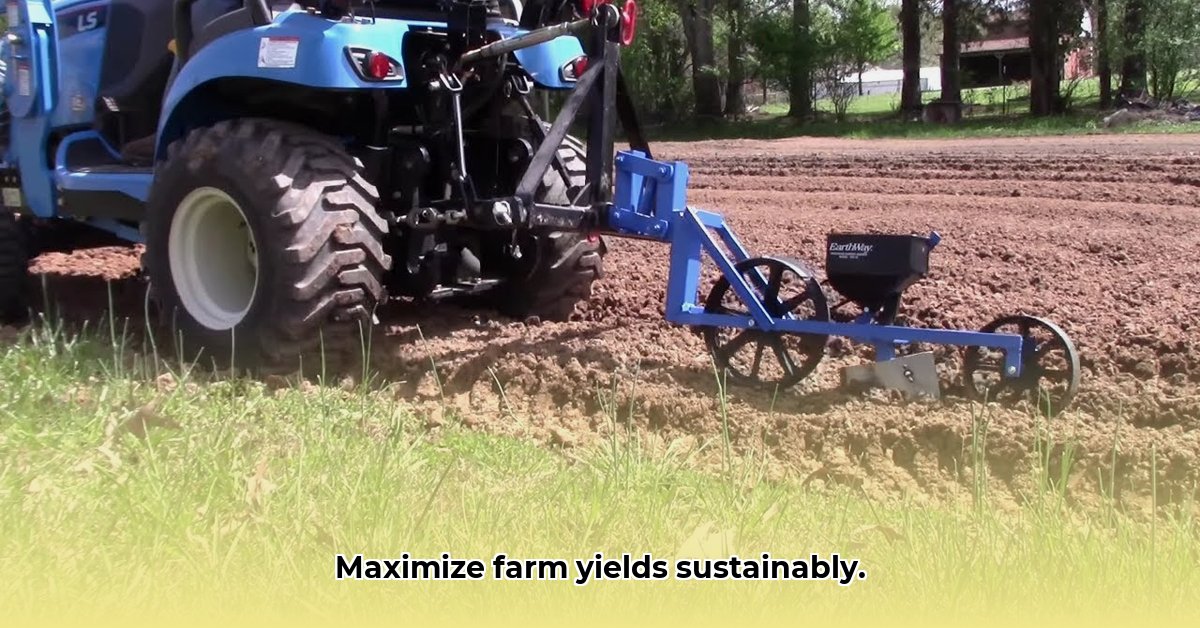
Understanding Small Tractor Planters: A Foundation for Sustainable Farming
Thinking about increasing your farm's productivity while minimizing environmental impact? Small tractor planters offer a sustainable solution, enhancing precision and efficiency for smaller farms and ecologically conscious growers. This guide will help you navigate the selection, setup, operation, and maintenance of these valuable tools, maximizing your harvest while minimizing your footprint. Precision planting isn't just about technology; it's about integrating technology into a holistic sustainable farming approach. But is it the right choice for your farm and crops? Let's find out. For more on tractor implements, check out this helpful resource on tractor attachments.
Types of Small Tractor Planters: Choosing the Right Tool for the Job
Selecting the right small tractor planter is crucial; the wrong choice can significantly impact your efficiency and yield. This section explores common types, highlighting their strengths and weaknesses to help you make an informed decision. Remember, the “best” planter is the one that best fits your specific needs and resources. What are your specific requirements in terms of crop type, acreage, soil conditions, and budget?
Mechanical Planters: These are the simplest and most affordable option, often utilizing rotating disks or cups to plant seeds. They are easy to maintain and suitable for smaller farms with simpler crop rotations. However, planting precision is less refined, potentially leading to uneven spacing. Think of them as the reliable workhorses of the planting world.
Pneumatic Planters: These utilize compressed air to precisely place seeds, offering superior accuracy and speed, especially beneficial for larger fields and diverse crop types. The higher precision generally leads to more uniform stands and increased yields. While more expensive upfront, the long-term benefits in efficiency and yields often outweigh the initial investment.
Vacuum Planters: These advanced systems use suction to handle seeds, ideal for delicate seeds that might be damaged by other methods. This results in the highest degree of planting precision, ensuring optimal germination. Though they’re the most expensive and complex, they are unmatched for high-value crops with smaller, sensitive seeds.
Here's a table summarizing the key distinctions:
| Planter Type | Pros | Cons | Ideal For |
|---|---|---|---|
| Mechanical | Simple, affordable, easy maintenance | Less precise, slower planting speed | Small farms, simple crop rotations, budget-conscious growers |
| Pneumatic | Precise planting, faster speed, better seed distribution | More expensive initially, requires more maintenance | Medium to large farms, diverse crops, efficiency-focused |
| Vacuum | Excellent precision, gentle seed handling | Complex, most expensive, specialized maintenance required | High-value crops, delicate seeds, precision farming |
Choosing the Right Planter: A Decision-Making Framework
Selecting your planter requires careful consideration of several interconnected factors. It's akin to selecting the right tool for a specific task – a perfectly sized wrench for a specific bolt.
Crop Type: Different crops have unique seed sizes and planting requirements. Choose a planter compatible with your specific crop needs. Ignoring this step could drastically reduce your yield.
Acreage: Planter capacity directly relates to your farm size. Larger farms require higher-capacity planters to ensure timely planting completion.
Soil Conditions: Soil type and conditions influence planting depth and method. A planter must be suitable for your soil's specific characteristics. Clay soils, for example, require a different approach than sandy soils.
Budget: Planters vary significantly in price, and associated maintenance costs should also be factored into your budget. This is critical to ensuring long-term viability.
Setting Up and Operating Your Planter: A Step-by-Step Guide
Proper setup and operation are paramount to successful planting. Even minor errors can significantly affect your yield. Follow these steps for optimal performance.
Pre-Planting Inspection: Thoroughly inspect your planter for any damage or missing parts before beginning. This preventative measure saves time and potential losses. "Prevention is always better than a cure," says Dr. Emily Carter, Agricultural Engineering, Purdue University.
Calibration: Accurate calibration is essential for consistent planting depth and seed spacing. Your planter's manual provides detailed instructions – take your time! Inaccurate calibration can directly translate to reduced yield.
Attachment and Securing: Securely attach the planter to your tractor, ensuring stability to prevent uneven planting or safety hazards.
Depth Adjustment: Adjust planting depth according to your soil type and target crop. This is crucial for optimal seed germination.
Seed Flow Monitoring: Regularly monitor seed flow to catch and address any clogs or inconsistencies immediately. Consistent seed flow is vital for uniform germination.
Consistent Speed: Maintaining a uniform planting speed avoids uneven seed distribution and depth.
Maintenance and Repair: Maximizing Lifespan and Minimizing Downtime
Regular maintenance significantly extends the life of your planter and minimizes downtime. Think of it as regular checkups for your valuable equipment.
Cleaning: Clean your planter after each use to remove debris and prevent damage.
Lubrication: Lubricate moving parts according to the manufacturer's recommendations to reduce wear and tear.
Inspections: Regularly inspect components for wear and tear, replacing damaged parts promptly.
Seasonal Maintenance: Perform seasonal maintenance procedures as outlined in your planter’s manual.
Integrating Your Planter with Sustainable Practices
Small tractor planters are perfectly suited to sustainable farming methods. Note that precision planting reduces input costs. Precision planting is not an isolated practice, but rather a crucial component of a broader sustainable agricultural system.
No-Till Farming: Precision planting minimizes soil disturbance, reducing fuel consumption and soil erosion, both environmentally and economically beneficial.
Cover Cropping: Planters can be adapted for the planting of cover crops, improving soil health and reducing erosion.
Precision Fertilizer Application: Combining your planter with precision fertilizer equipment optimizes nutrient use, reducing waste and environmental impact.
Data Management and Analysis (for Advanced Models)
Some advanced planters collect data on planting parameters. This data provides valuable insights into planting uniformity, helping you to refine your approach for better outcomes in subsequent seasons. This data-driven approach allows for continuous improvement and optimization of your planting practice.
Conclusion: Reap the Rewards of Sustainable Precision Planting
Investing in a small tractor planter offers numerous benefits for farmers seeking efficiency, sustainability, and increased profitability. By carefully selecting the right model, following proper setup and operating procedures, and performing regular maintenance, you’ll enhance your farm's productivity while contributing to a more sustainable future. Remember, precision planting is an investment in both your farm's present and its future success. Start researching the best planter for your needs today and start building a healthier, more productive farm.